I've been receiving various collaboration invitations over time—cosmetics, skincare, clothing, shoes, you name it. I usually try my best to accommodate them because I know my current performance doesn't compare to bloggers with larger followings. That's why I always ask clarifying questions during communication and want to understand the collaboration details.

For example, I need to know upfront whether it's an image-text collaboration or a long-form blog post, so I can gauge what I'm actually able to help with. But I recently received a collaboration request that didn't sit right with me. I want to be clear that this post is absolutely not meant to attack anyone—I personally handle and evaluate every invitation I receive. However, the other party's explanation was really unclear, and this was the first time I formally rejected a collaboration.

When the person initially messaged me, it got filtered into my spam folder. I usually check spam periodically, so I replied after some time had passed.

Their initial message was: "I wanted to inquire if I could collaborate on an article feature with you?" The use of the word "collaborate" made me wonder if they wanted free collaboration in exchange for traffic, so I asked further about the format. They replied that they wanted to collaborate from "a blogger's perspective." I was confused—weren't they looking for bloggers in the first place? Why emphasize again that they want a blogger's angle? There was also a typo, but that wasn't a big deal.

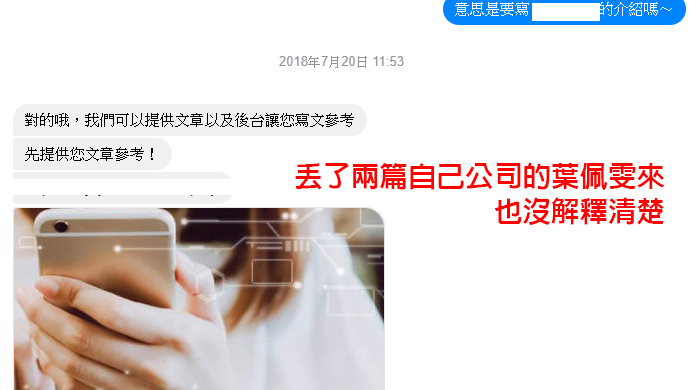
Then they started telling me they had "developed a fan system tool" and wanted to combine social media interaction and peripheral marketing (the white area is the tool name, which I pixelated). They asked if I could write about it. At this point in our communication, I had no idea what product they wanted me to collaborate on or what exactly they wanted me to write about.

Based on past examples, the other party should have provided a "product introduction PPT," features, or a relevant website where I could learn about the product and assess whether collaboration was possible. But at first, maybe it was my comprehension issue—I genuinely wasn't sure what product they wanted to collaborate on. This isn't something everyone would immediately understand. I even had to search for the company myself to realize that their "fan system tool" was what they wanted to collaborate on.

Later, they just sent me 2 articles written by Ye Peiwen from their own company. Of course, I could use these two articles to get a preliminary understanding of the product. But after evaluating it, I concluded this product was better suited for e-commerce bloggers, influencers, or companies that actually sell products—because the system is marketed as an "O2O marketing tool" that allows you to send discount vouchers and products to fans through interactive games.

From the start, they positioned it as a tool for physical-to-physical interactions. Finding a blogger like me who specializes in writing articles and book reviews, with no physical products or physical stores, simply wasn't a good fit. I didn't know how I could help, and I didn't even know how I would use this kind of tool to interact with my audience.

Moreover, they still hadn't explained "what form of collaboration" they wanted, and they didn't ask about my budget. So I still felt they were looking for a free collaboration in exchange for exposure. Additionally, the articles they provided were the company's own internal introductions, and the examples they gave were all collaborations with other physical brands. For me, this offered no real benefit, and I doubt it would have for them either. This wasn't a collaboration style I was comfortable with, so I explained my thoughts and provided my rates.

However, they responded by asking me "approximately how much?" I was confused about why they would ask again, because I had been very clear earlier about budget and format. At this point, I already felt that communicating during the collaboration would be difficult, so I was mentally prepared to reject. But I still responded.

What they said was that they didn't know how many words the article should be... This is where I'll summarize how I've handled invitations in the past and how to do it better to avoid communication difficulties.

1. Assess the product type and exposure expectations upfront:

Based on past practices, clients need to estimate the collaboration format and required word count, and then both parties can assess and find a middle ground. If there's an internal budget, you should have a rough estimate and discuss it together. If a collaboration works like this one, it will likely make the other party feel that you don't even understand your own product or collaboration conventions—creating hesitation about continuing the partnership.

2. Does the collaboration partner align with the product?

Clients should first explain why they chose this particular collaboration partner—what they've observed and understand about them—to build trust. This shows you're not just shooting in the dark. Provide a preliminary product introduction and explain what level of help you're initially hoping for, allowing the other party to assess whether they can handle it. Don't make the collaboration partner constantly guess what you're thinking. Even if they were initially eager to collaborate, their enthusiasm might be dampened.

3. Reference examples:

I think providing the company's own official website and articles written by internal staff isn't ideal. Instead, provide examples of past collaborations, because it's hard for the collaboration partner to envision what they could actually produce. When seeking a collaboration partner, you should also evaluate what the other party can contribute. If this kind of product was initially meant for me to explain social media phenomena and analyze cases, I think I could handle that better. But the fact that I had to suggest this approach made the client seem like they didn't understand their collaboration partner well enough.

Ultimately, I rejected this collaboration. I felt a bit bad about it, but I believe that in making an invitation—even as an assistant—you represent your company's image. To this day, I still don't know much about the company's background or what benefits the product could bring. That's a shame. So I've organized this communication process as a reference for others.

Thank you to everyone who has given me the chance to collaborate :)