
(Photo / Yingliang Group Warehouse No. 5 General Manager – Liu Xin)
"We only serve high-end clients," said Liu Xin, General Manager of Yingliang Stone Materials, right from the start. With clear target customers and precise business strategies, "building brands, not markets" is the operating philosophy of Yingliang Stone Materials' self-created brand "Warehouse No. 5."
Yingliang Stone Materials was originally a stone processing factory in Shuitou.
How did this small enterprise transform into Asia's largest stone materials distribution group and artistic stone company?

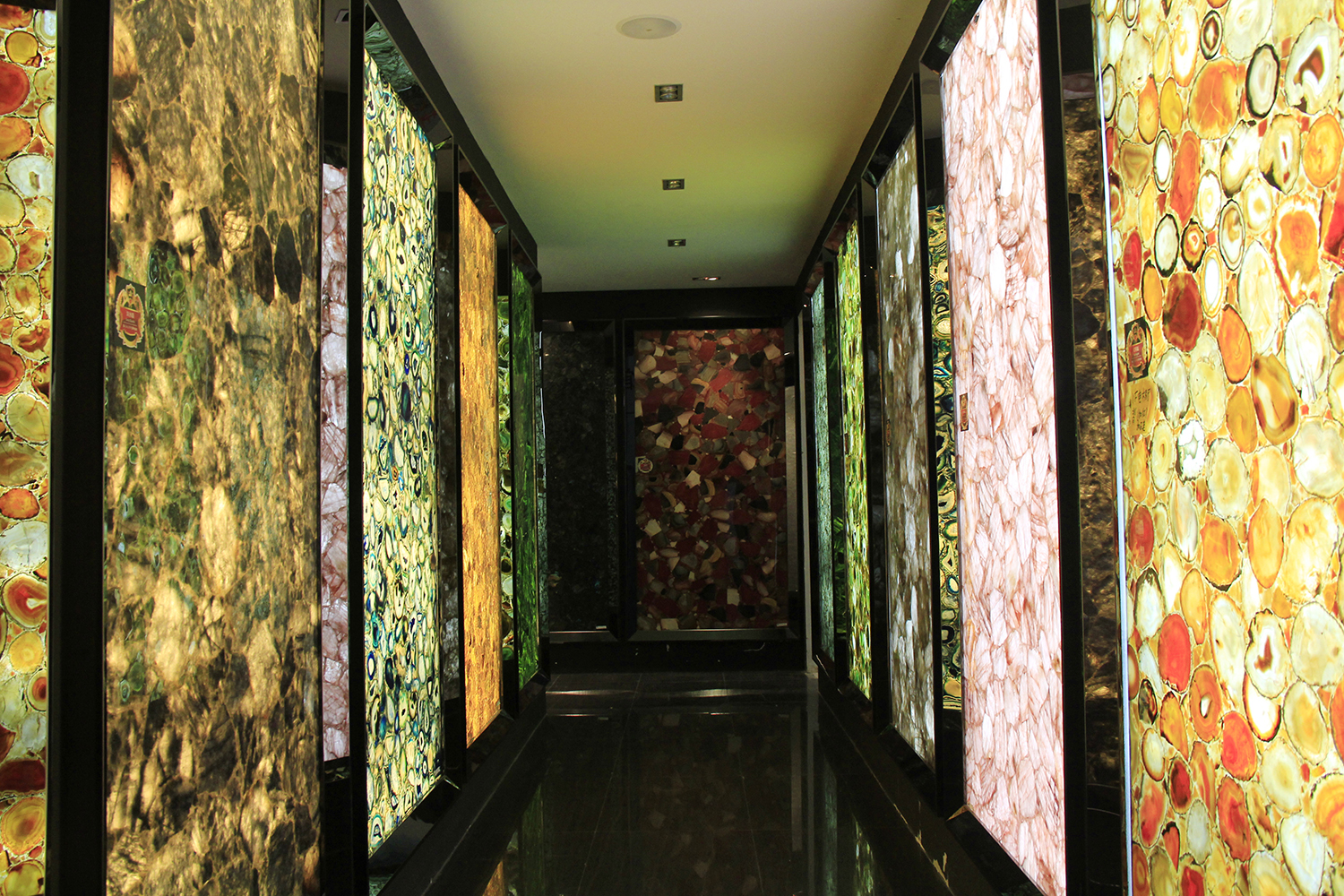
(Photo / The warehouse resembles a premium stone showroom)
"Buy stones, sell stones, go to China, find Shuitou" — this is a popular saying circulating among overseas stone material merchants, and Yingliang Stone Materials is located precisely there. Yingliang's business encompasses mine development, rough stone sales, slab and specialty processing, engineering decoration, real estate, and many other fields, with branch offices in all major first-tier cities nationwide.
In the past, the stone materials contract manufacturing model formed in Shuitou kept the industry at the low end of the global supply chain. Companies that relied solely on stone processing gradually reached a bottleneck. Yingliang Stone Materials developed its own artistic stone brand, elevating the stone materials industry from the low end to the high end of the supply chain. It is now Asia's largest stone materials supplier. The group's chairman Liu Liang once stated that Warehouse No. 5 guides the industrial cluster toward transforming its economic development approach.
Despite seemingly having excellent geographic advantages and abundant resources, Yingliang Stone Materials once faced corporate transformation challenges. Liu Xin said, "Pure trading cannot resolve the supply-and-demand hierarchy issues in stone materials, nor can it establish a foothold in the entire industry." Therefore, facing numerous stone merchants who were establishing processing factories in coastal cities, causing market fragmentation, to differentiate itself from other industries, Yingliang chose to transition from a processing factory to operating its own brand, establishing Warehouse No. 5.

(Photo / The Louis Vuitton of the stone industry)
Warehouse No. 5 houses over 200 of the world's most premium and unique stone treasures. Setting aside preconceived notions, Warehouse No. 5 is essentially an artistic display, slab sales, and luxury experience center combined into one stone showroom. Qi Fei, the executive director of Warehouse No. 5, once said that Warehouse No. 5 operates with the goal of "enhancing brand value," transforming stone into an art form, with the ultimate aim of becoming the "Louis Vuitton" of the stone industry.
Yingliang Stone Materials targets high-end customers with its brand services. The brand's positioning of "new, rare, and special" reveals the company's unique operating philosophy. Liu Xin explained, "New" refers to new varieties, representing a brand willing to explore new frontiers, seeking new stone materials in the role of a pioneer. "Whenever there are new varieties, we want to incorporate them into our platform," expanding the range and variety of products.

Liu Xin went on to explain that "rare" means collecting unusual and exotic stones from both domestic and foreign sources, classifying them into various limited-edition stone series, "even if some are out-of-print," acquiring them at premium prices and organizing them into fashion editions, premium editions, collector's editions, and limited editions to attract different types of customers from various countries, thereby enhancing brand appeal. Notably, limited editions may feature fossils and fish bones, "which become our household treasures — no matter how much customers offer, we won't sell them."
"Special" means distinctive, further emphasizing the importance of "rare," differentiating from the abundance of varieties on the market. Liu Xin said, "The price isn't particularly expensive, but it's simply full of rarity." These three operating values allow Yingliang Stone Materials to continuously innovate and reinvent itself, solidifying customer confidence in the enterprise's brand.
Regarding corporate strategy, Liu Xin pointed out that in the domestic market, beyond stone manufacturing, the company is involved in crafts, fireplaces, tiles, tea trays, and bed boards. The diversified product portfolio not only expands the company's reach but also gradually establishes Yingliang Stone Materials as a benchmark enterprise in each product category. This validates the economic theory that industrialization is the foundation of internationalization, internationalization is the key to surpassing the peak, and internationalization is the driving force of enterprise operations.
Additionally, the group's conglomerate operational model integrates from upstream raw material transportation to downstream design and sales vertically, complemented by horizontal integration in tourism, machinery, and other industries, creating an independent large-scale company with market presence. This ensures the brand has greater domestic assurance and greater influence in public consciousness.
Regarding overseas strategies, Yingliang Stone Materials actively expands and maintains friendly relationships with international markets in various ways. Liu Xin said one of the most direct methods is participating in stone design exhibitions held overseas, seeking possible cooperative relationships at exhibitions while increasing the company's international visibility.

Beyond establishing new cooperation opportunities, Yingliang Stone Materials also maintains contact with long-term partners and major bulk traders through import-export companies and conducts regular follow-up visits to retain old customers. Furthermore, Yingliang Stone Materials invests heavily in the Xiamen International Stone Fair, one of the world's three largest stone design exhibitions held each March, showcasing its brand appeal to customers from various countries. Simultaneously, leveraging the exhibition's extremely high international reputation, the company expands its foreign market reach significantly.
Yingliang Stone Materials, from top to bottom and from domestic to international operations, has seized opportunities, moved methodically, and expanded the company's market with strategic planning. This has enabled the original stone processing business to successfully transition from the low end to the high end, which is the secret to becoming Asia's largest stone materials distributor.
Shuitou, adjacent to Xiamen, possesses tremendous geographic advantages and handles 70% of the nation's stone import-export business. However, Liu Xin noted that the overall stone market is no longer as "booming" as it once was. With emerging large companies entering markets in various locations and major markets appearing in every region and watershed, the market that was previously concentrated in coastal areas like Beijing and Tianjin has reduced Shuitou's export volume.

(Photo / Visiting Quanzhou as a Taiwan representative)
Beyond industrial transformation and brand development, regarding future direction, Liu Xin believes Shuitou's competitive advantage lies in its distinctiveness. Although prices are relatively high, the quality surpasses other enterprises, naturally attracting high-end customers.
According to Manager Magazine, four characteristics of long-lived enterprises are keen sensitivity to environmental changes, strong cohesion and identity, high inclusivity, and financial control. Yingliang Stone Materials clearly understands its corporate philosophy and customer targets, transforming its industry as the environment, economy, and policies change. Moreover, Shuitou's recognition of the local stone industry's culture is equally critical to supporting Yingliang Stone Materials' sustainable development and success.
Yingliang Stone Materials will establish a home decoration operations center in the future. Liu Xin believes that large-scale engineering and technical capabilities have gradually matured and are about to enter new domains. With China's recent economic development boom, the market is enormous. "All these homes need decorations made of stone," and the acceptance of interior decoration using stone is increasingly growing. Liu Xin expressed the hope that the company will eventually become a household name, flourishing everywhere, thereby gaining global pricing power and discourse power.
(Original article from 2014, a competition entry created with a group of outstanding partners in Quanzhou)