Cross-Industry Thinking is Karen's live streaming show that airs every Wednesday night. Each week, she invites a guest to talk about their workplace story. On 5/8 at 8:30 PM, she's inviting ritual body specialist Yang Yuanen to share his story.
Yuanen is a funeral industry professional who was originally just a cosmetics counter girl at a department store, and has always had a strong interest in makeup. In high school, he actually considered becoming a corpse makeup artist, but being young at the time, every so often he would pursue a new aspiration (young people are young people after all!)
However, the thought of becoming a corpse makeup artist kept returning to him at different stages of life, flashing through his mind unexpectedly. In recent years, the desire to become a corpse makeup artist grew stronger and stronger, so he applied to work as an assistant at a funeral home in Zhongli. He naively thought the funeral industry was all about applying makeup to the deceased. Little did he know that the funeral industry is so specialized.
Applying makeup to corpses and washing/dressing them — ritual assistants basically never handle these tasks directly. Many funeral homes outsource this work to contractors. The one he applied to was like that too; you only get a real chance to be involved in this kind of work when you're on duty at the hospital morgue.
While working as a ritual assistant, I witnessed many things that families of the deceased never see, such as: washing and dressing... The first time I saw a standard washing and dressing procedure at a funeral home, I was truly shocked. So this was what a standard wash-and-dress looked like.
I saw many deceased lying face-down on metal trays, with their buttocks lifted by the washing staff, their bodies forming a "V" shape, each one's rear end held up high and supported to make it easier for staff to dress them; at a glance... you could see a whole row of bodies, completely naked, stripped of all dignity and privacy, lying face-down on the metal trays; I was truly shocked in that moment, not because I saw so many bodies at once, but because... the so-called washing and dressing of the deceased turned out to have so little dignity and privacy, which is why funeral homes won't let families watch. If... the person lying there was my family member, could I accept it?
Then suddenly a funeral home urgently wheeled in a deceased person, saying "hurry up, we're running late," and I saw the person pulled from a body bag onto the metal tray. After their clothing was cut open, the washing staff took out alcohol and just sprayed it on the deceased, wiped them down with a towel, and directly put on the funeral robes and wheeled them out. They didn't even remove the diaper on the deceased's body before putting on the funeral garment.
In that moment, I truly didn't know how to describe how I felt. I only felt so sad and heartbroken, because the elderly man who was sprayed with alcohol and wheeled out appeared to have been ill for a long time before passing. For people who have been ill for so long, they usually spend a long time bedridden and have never actually taken a proper bath — at best they're just wiped down; but even after death, the old gentleman never got to take a bath. By the end of life, even his departure couldn't be clean and dignified. Then his funeral service is held grand and ceremonious — does that really have meaning? Is that really what showing filial piety is?
After this shocking wake-up call, my thinking began to change. What I hoped to do was ensure that those who pass away do so cleanly and with dignity as they complete the final chapter of their lives. Every deceased person has family members who love them. If the roles were reversed, if my family member was lying there, I definitely could not accept this kind of washing and dressing. No one wants their family member to be treated this way. You and I would feel exactly the same.
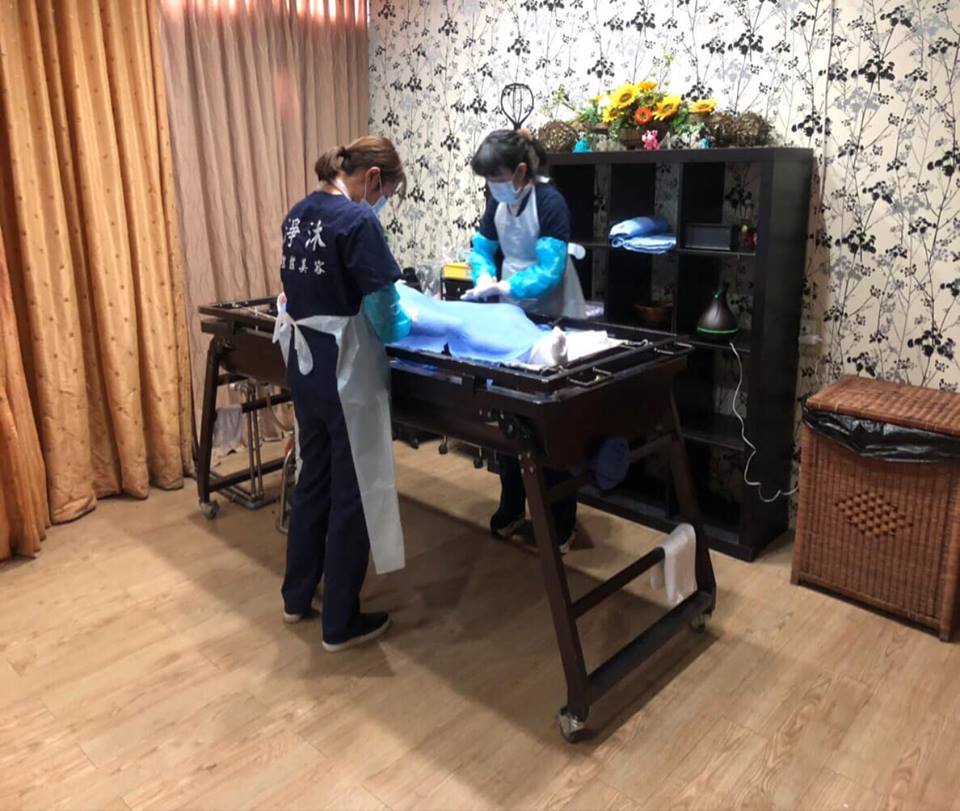
Eventually, I left the funeral home and began learning about ritual body care — ritual body care is what's commonly known as a corpse spa. It involves sprinkling aromatic essential oils on the deceased's body before washing, after which family members participate throughout. Three areas remain covered at all times. We wash the feet, face, and hair, and even provide massage treatments that match the standards of a real-life spa. After the body is cleansed, we dress the deceased, and finally complete the process with makeup. The entire ritual body care service is then complete. Throughout the process, family members can be present, and they get to say their final farewells to their loved one.
After doing ritual body care, I noticed that at each service, when family members wash their loved one's hands and feet for the last time, tears stream down every family member's face. During the funeral process, there are always so many tedious matters to handle. Beyond dealing with funeral arrangements, they must also welcome friends and relatives coming to pay respects. The family members' grief is temporarily suppressed in their hearts because they need to stay composed to handle subsequent matters.
The body spa usually takes place the day before the farewell service. At this point, family members suddenly realize how quickly time has passed. After washing, it's truly time to say goodbye. During our washing process, family members finally get to release all their grief and emotions. Even words they didn't have time to say are finally conveyed to their loved ones at this moment, and they can fulfill their final act of filial piety here.
When family members thank us after finishing, that moment is truly more precious than anything else, because their loved one is also our family member. We understand that desire to give family members the very best. Perhaps the concept of ritual body care hasn't caught on yet, but I hope that in the days to come, more people will understand the significance of ritual body care — so that the final moment of life can be clean and dignified, and so that family members have more time to say a proper goodbye to their loved ones.