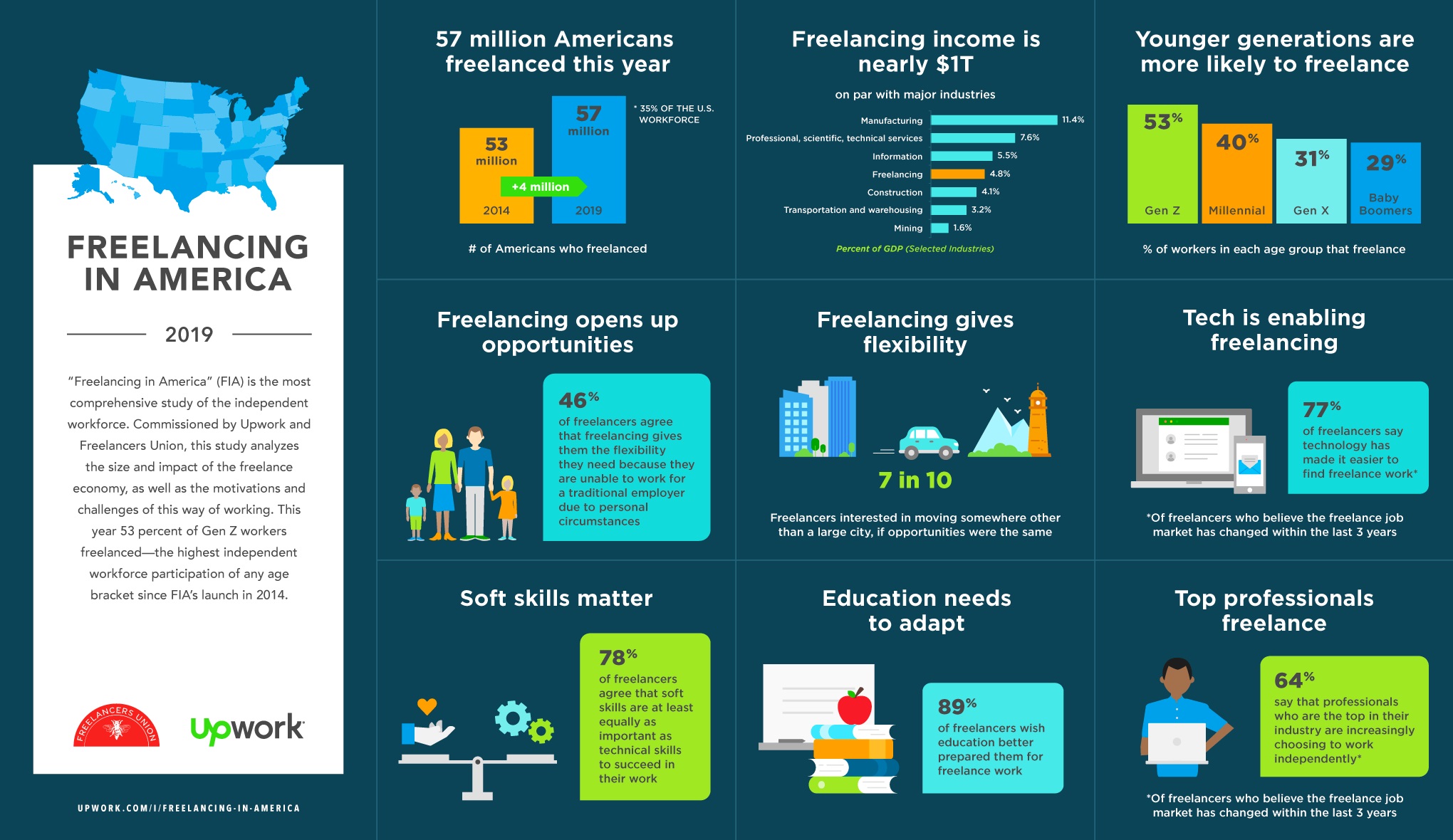
Let me start with the conclusion: why working outside an office will become the future trend. On October 3, 2019, Upwork, a US freelance job marketplace, and the Freelancer Union jointly released a report showing that over 57.3 million Americans engage in freelance work, an increase of 4 million since 2014. Among Generation Z (born between 1995-2000), 53% are freelancers. The total income of freelancers is nearly $1 trillion, accounting for about 5% of GDP—exceeding the contribution of the US construction industry. **(Original Report)****
**
A Pew Research Center report also predicts that by 2020, 40% of American workers will be freelancers with short-term contracts rather than permanent company employees, earning a living through the gig economy. Friends who haven't completely left the corporate system may disagree that freelancing will become a trend. In fact, the reason lies in the fact that these people haven't experienced the flexibility and beauty of freelance work (of course, there are various pressures as well). On the other hand, they can't resolve the complex tax issues, contract negotiations, and other matters that come with independent income. Additionally, education and values may influence them—they've only ever known the path of "graduate and find a good job," and from there, life doesn't change much.
Recently, I was invited to recommend a book: "Earn More Without Going to the Office: Build a Hybrid Career to Create a Self-Directed Life, Live Without Compromise, Work Freely". I believe the "without going to the office" in the title means not working for others, not literally not working. The author is an American journalist who later established her own website and gradually took on freelance projects. Now she has 4 million podcast listeners. So, how does one do it?
When I was 25, I felt my life was essentially over. No matter what career I switched to, I could only do work where I couldn't control everything, constantly accommodating others, learning to read faces, situations, supervisors, and colleagues' moods before speaking or making decisions. Even being careful, I'd still be called out for trivial mistakes. While I'm busy outside, I'd receive a phone call questioning me: "Do you know everyone is cleaning up your mess?" I originally thought the person needed a solution from me, but no—the call was just them venting their emotions.
This scenario has probably happened to many of us. In this era, no one wants to please others; everyone just wants to be themselves. But various external factors always force us to ignore the voice within. In the past, I also went through such struggles. Working in an office, I could complete tasks quickly and well, but there was always an uncomfortable feeling of being restrained. Recently, I took my first "resignation without notice" to give myself time to reflect. I discovered I love the feeling of controlling my own life. Simultaneously, I realized that once I put myself out in the market, I saw how many people are willing to pay for my skills—and often, we underestimate ourselves.
However, what abilities should one have to become a remote and freelance worker? Based on my long-term observation and personal experience, I've identified 5 key skills: (Related Reading: Gig Economy Transformation! From Slash Career to Multiple Income Streams, Building Personal Branding)
1. Irreplaceable Expertise
To become a freelancer or remote worker, the most important thing is to have 1-2 irreplaceable areas of expertise. Many people might lack this, but your specialty is likely something you excel at exceptionally well—something no one does better than you. For me, I'm good at writing articles. What's particularly special is that whether short, medium, long-form, or deep commentary, I can adjust my tone, thinking, and style according to the platform's characteristics.
2. Multitasking Ability
Because freelancers don't have a company to handle taxes, contracts, project progress, etc., they must know many things. For instance, I've been troubled by the difference between "freelance income" and "fixed salary," and each case has different rates and tax implications. Administrative work like this is one task. Additionally, if you're writing articles that need graphic design, some people outsource, while others can handle everything from text to visual design themselves.
3. Communication Skills
Communication is already recognized as an indispensable workplace skill for the future. I believe communication isn't just about talking or typing well—it's about clearly expressing your thoughts. Don't underestimate this; most people now use text instead of face-to-face dialogue. Text and email are "non-real-time," so there's time to think. However, when you need immediate communication like phone calls, presentations, or meetings, both parties' logic and communication affect the meeting's progress and mutual understanding. Since freelancers have no company, when you go out, you represent yourself. There's no opportunity to blame it on the company image, so communication skills are especially crucial.
4. Self-Discipline
I believe this key point lies in self-requirements and understanding your own work progress. Many self-disciplined people can thoroughly understand how much time they need to complete a task. For video production, work might involve signing contracts, writing scripts, shooting, editing, rough cuts, post-production, scheduling, publication, and closing. Many professionals know how much time each task requires—for example, signing a contract might take 1-2 weeks of back-and-forth communication, writing a script needs 3 hours, etc.—and schedule these in appropriate time slots.
Beyond scheduling, another crucial aspect is learning to "decline" tasks you can't handle. I'm practicing this too. Sometimes I receive collaboration requests I really want to accept, but due to insufficient ability or capacity, I need to learn to prioritize and postpone work items.
5. Integration Ability
The above skills need to come together to integrate seemingly unrelated tasks and create maximum value with half the effort. This depends on the freelancer's integration ability. For example, I know remote workers who produce podcasts, convert the transcripts into articles, and eventually publish a book, accumulating fame—a modern "butterfly effect." Therefore, taking inventory of your resources becomes very important.
(Next time, I'll share my experience as a remote worker in the Philippines)