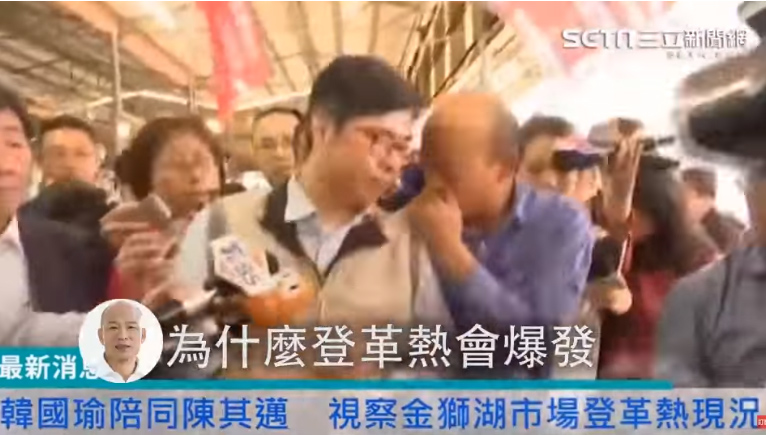
Kaohsiung has recently seen 18 dengue fever cases, accounting for the entire national total of 18 cases. Premier Su Tseng-chang publicly criticized Kaohsiung Mayor Han Kuo-yu for traveling across Taiwan focusing on a presidential bid while neglecting his mayoral duties. On June 19, he dispatched Vice Premier Chen Chi-mai to Kaohsiung to personally oversee epidemic prevention meetings. However, Han Kuo-yu covered his mouth and whispered into Chen's ear asking "Why did dengue fever break out?" Television cameras captured everything, sparking controversy and drawing Han further into public scrutiny.
Television camera microphones cost approximately 100,000 yuan each and are unidirectional microphones equipped with windscreen protection. When positioned accurately, they can capture subjects' whispered remarks clearly even in noisy environments—they can even pick up the distinct sound of water pouring into a cup, and the audio quality remains pristine even at higher volumes.
Based on Han and Chen's body language interaction, Han clearly covered his mouth and deliberately lowered his voice while whispering into Chen's ear: "Why did dengue fever break out? This recurring outbreak is the real problem." He clearly didn't want media or onlookers to know.
However, the television microphone was positioned right next to Han's mouth, and covering his mouth actually amplified the sound effect. In contrast, Chen's response—"There are more disease vectors, and the environment here is complex with the Dajung Interchange, Jinshi Lake, the Funeral Home, and wetlands all in the vicinity"—wasn't blocked by his hand, so the audio wasn't captured as clearly.
Reviewing political figures who've been caught by "microphone moments," recently KMT Legislator Chiang Wan-an was caught occupying the speaker's podium saying supporters of Han Kuo-yu "lack rationality," letting his true thoughts slip. He overlooked that the microphone hadn't been turned off and the entire scene was being broadcast live. Some of Han's supporters who heard this flooded Chiang's social media with abuse, forcing him to apologize and clarify his position.
In February 2019, Taipei Mayor Ko Wen-je was caught cursing while discussing Democratic Progressive Party city councilor Hsu Shu-hua with then-Parks Director Huang Li-yuan on Yangmingshan. The entire conversation was broadcast live, and the councilor even held a press conference tearfully claiming victimhood. Ko later responded that it was a "non-public occasion, private inquiry" about azalea cultivation, and the parks director also maintained it was a "private" statement to the mayor about "certain councilors' concerns."
Was this truly a "private occasion"? In reality, during media interviews, microphones remain on throughout and record all captured audio, with editors later selecting relevant segments. Political figures shouldn't assume that conversations in media presence can be treated as private remarks not reflecting their official positions. When unguarded remarks slip out in such situations, they become "records of official hypocrisy," potentially swaying voters.
Microphone Types:
Omnidirectional
Omnidirectional microphones have equal sensitivity to sounds coming from different angles. They're commonly used when recording entire environmental sound, when sound sources are moving and consistent pickup is desired, or when collecting multiple sound sources simultaneously, such as during online conferences. The downside of omnidirectional microphones is they easily pick up surrounding environmental noise. The manufacturing process is simpler and prices are relatively cheaper.
Unidirectional
Common unidirectional types include cardioid or hypercardioid patterns, which offer optimal pickup from sounds in front of the microphone while attenuating sounds from other directions. This is designed for targeted pickup in the microphone's designated area. Manufacturing differs slightly from omnidirectional microphones, making prices higher, but they don't easily pick up noise. For users who prefer to avoid surrounding environmental noise, unidirectional microphones are the best choice.
Han Kuo-yu and Chen Chi-mai were previously rivals in Kaohsiung mayoral elections. Once this conversation became public, it sparked public criticism questioning whether Han was truly focused on city administration. Meanwhile, Chen, despite his promotion to Vice Premier, personally returned home and directly identified in this conversation the likely causes of disease vectors and the affected areas in Kaohsiung, earning him recognition from many as the "true Kaohsiung mayor."