By Karen Young
The world's largest photo and image sharing platform. Currently has over 800 million users, with high penetration in Taiwan. Beyond attracting young people, major brands have flocked to Instagram, hoping to reach more consumers.
IG Community #Generational Labels TimeLine
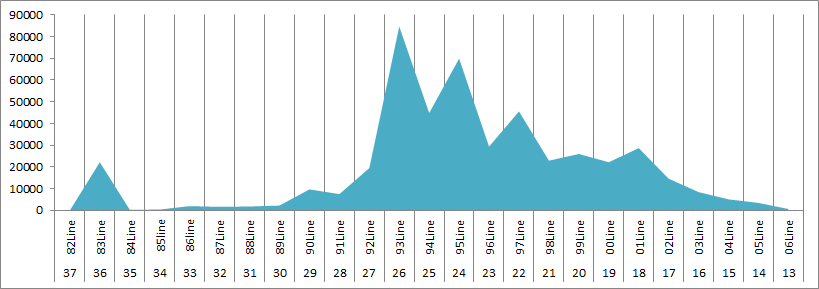 IG Generational Labels Statistics (as of 2019/5/16, continuing to rise / compiled by Karen Young)
Right from the start, let me address the main topic. Looking at the IG #generational labels distribution chart, this long timeline represents something, doesn't it? Are you filled with questions—what does #90Line mean, what does #94Line mean? If this is the "shared sentiment" of a generation, why has #83Line data surged? Let me explain slowly.
First, let me introduce which generation I belong to (coughs), I was born in 1990, just catching the tail end of the 90s generation, still young enough to pretend. With this label classification, I am #90Line, which happens to be at the starting point of the #generational labels. But what does LINE represent?
Actually, this usage originated from Korean K-POP artists. To understand this, we need to explore Korean traditional culture. Koreans place great importance on "hierarchy." Whenever meeting someone new, they first confirm each other's birth year to decide how to address each other. You can see this interaction in Korean dramas as well.
Influenced by this culture, Korean artists began using these hashtags on social media, combining their birth year with LINE to create exclusive labels. Why the English word LINE? It carries the meaning of Channel, representing that everyone born in that year shares the same alignment. To feel closer to their idols and create a sense of belonging, fans follow suit and label themselves, sparking a social media effect.
For concrete examples, someone born in 1993 becomes #93Line, someone born in 1998 becomes #98Line, and anyone born after 2000 naturally becomes #00Line. Many young people not only tag themselves in posts but also add these labels to their personal bio sections.
Karen personally compiled and investigated IG hashtags in this format by year and created a chart. I discovered some interesting patterns. Let's start with the most popular post-90s generation to analyze and break down for you.
 (as of 2019/5/16, continuing to rise / compiled by Karen Young)
This chart covers 1990 to 1999, or people currently aged 20-29 using generational labels. #93Line has the most usage, reaching 84,700 times, suggesting that 26-year-olds use IG frequently. Next is #95Line with 69,900 uses (age 24), followed by #94Line (age 25) with 44,880 uses.
First, a notable phenomenon appears with #90Line (9,701 times) and #91Line (7,513 times)—currently 28-29 year-old working professionals. During their college years, most used Facebook for communication and message sharing, so they have higher Facebook dependency and lower IG usage frequency compared to #92Line (19,500 times) and later. This initially reveals differences in social media tool usage.
You might wonder why #95Line has more labels than #94Line, and why the trend doesn't increase steadily but instead fluctuates. This pattern appears in #95Line and also in #97Line. First, within the #95Line hashtag, the representative artist is Jimin from BTS.
 Jimin from BTS is #95Line (Image / Screenshotted from IG)
BTS's talent and music swept the global music industry with the "Korean Wave," even taking the Billboard Music Awards for Best Group, beating Maroon 5. Additionally, Jimin himself was rated 25th on TC Candler's prestigious list of the world's 100 Most Handsome Faces, and the British Guardian recognized him as 17th in the "Best Boy Band Members of All Time TOP 30." His unique personal charm caused the #95Line count on IG to skyrocket.
Additionally, within #97Line, BTS member Jungkook, also born in 1997, makes the #97Line hashtag count (45,600 times) exceed the previous year's #96Line (29,400 times). Jungkook is the youngest member of the Korean boy group BTS, serving as a main vocalist, and his personal charm influences community hashtags.
 BTS's Jungkook is #97Line (Image / Screenshotted from IG)
You might then wonder, so only Korean artists use generational labels, and what does this have to do with social media tools? Actually, Korean artists are debuting at younger ages, with post-00s artists everywhere, but the data doesn't fluctuate accordingly. Below is a breakdown analysis of post-00s data.

From this chart, we can see #00Line hashtags total 22,200, #01Line hashtags total 28,700, then decline year by year with no more fluctuations, continuing until after #06Line, where data drops to zero.
This phenomenon appears for several reasons. First is policy direction: according to the US Children's Online Privacy Protection Act, Facebook and IG don't allow children under 13 to register accounts. According to this chart, this is "completely correlated" with the policy. But another consideration is that for children under 13 to 17-year-old teenagers, IG isn't their only social media tool!
So what does this generation actually use? First is ByteDance's short video tool "Douyin," where 15 seconds of content with music, video effects, and transition techniques form unique UGC user-generated content.
Tencent Intelligence Report shows Douyin has higher penetration in first and second-tier Chinese cities than Kuaishou, while the latter has higher penetration in fourth-tier and below cities, but the two don't form a clear user opposition. The report also shows that in both Kuaishou and Douyin, users are predominantly women under 24. Douyin has 92% users under 30, with nearly 70% being female.
In Taiwan, users are mostly elementary and middle school students, with many parents registering accounts for children under 13. Video content mostly includes dancing, hand gesture dances, and lip-sync videos. The report suggests the social short video market structure is initially formed, but variables remain large.
Another social platform is YouTube. According to official annual data, viewing time across all age groups rose from an average of 14.6 hours per week to 16.4 hours, meaning people spend nearly two and a half hours daily watching YouTube. Viewers aged 16-24 show the largest growth among all age groups. Users face no age restrictions and can adjust channels by preference. Compared to other social platforms with age limits, YouTube extends user age downward.
Returning to this article's topic, after analyzing 90s and 00s IG social behavior, let me turn back to analyze pre-90s—a special phenomenon.

#89Line to #82Line—currently 30-37 year-olds—show reduced IG usage. This results from two factors. First, this generation had limited internet hardware during their school years, so they didn't develop many social media tools and focused more on Facebook, creating higher Facebook dependency. Second, this age group is busy with work and family, gradually reducing social media usage time. Mobile banking social research data confirms that 25-34 year-olds spend 141 minutes daily on social networks, while 35-44 year-olds spend 105 minutes. However, the pre-90s generational label timeline shows #83Line surging to 22,200—a huge gap from other same-generation labels!
The reason is that Super Junior's Kim Heechul and Leeteuk were both born in 1983 and both love calling themselves #83Line. This caused the same year's data to spike, demonstrating celebrities' influence on IG's generational label culture. Beyond celebrities using the labels themselves, fans upload pictures and tag related comments, or add their generational labels to their IG bios seeking validation.

Many Taiwan enterprises still operate on Facebook and YouTube, some even thinking "post-90s" terms are Mainland Chinese slang, so they haven't followed the trend. However, social media culture isn't limited to specific regions—it's a generational trend.
It clearly shows Korean pop culture influences young generations' social media behavior. Younger generations are more susceptible to social media and internet culture influence. The reduced post-00s generational labels on IG might stem from several possibilities: first, post-00s don't trend toward self-labeling; second, too many social media platforms scatter attention. To penetrate the youth market, one must understand the language and gameplay to move hearts.