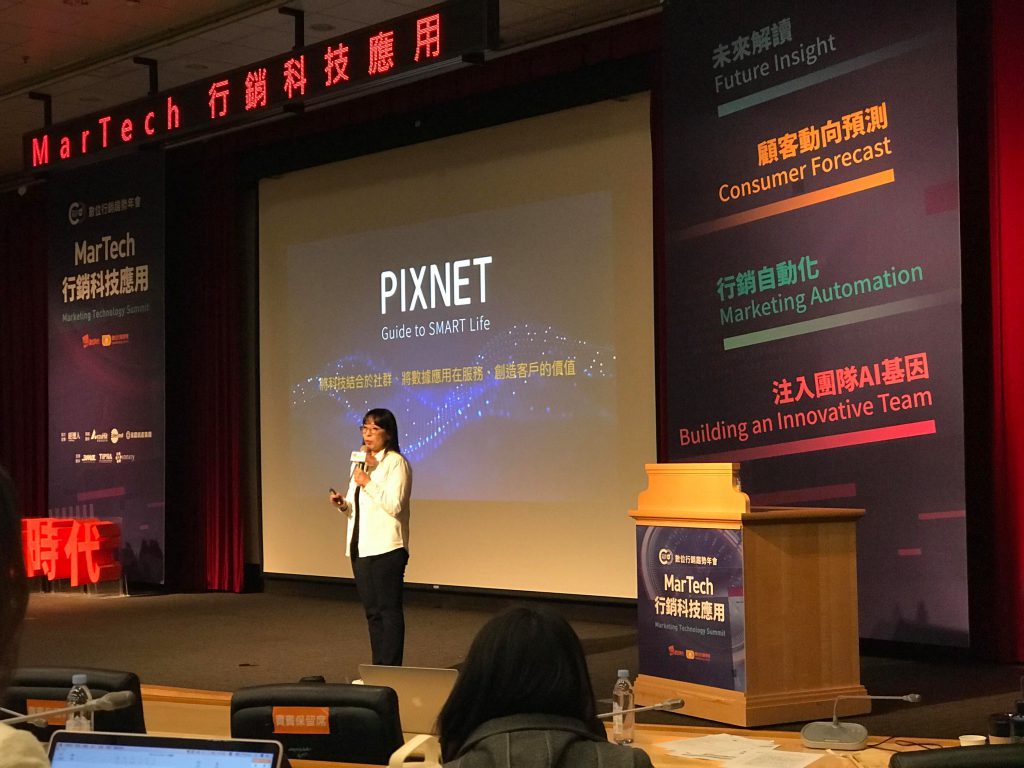
"If you have one hour to solve a difficult problem, you should spend 55 minutes thinking and use the remaining 5 minutes solving it." Pixnet CEO Zhou Shouzhen (Jenny Chou), speaking at the 2019 Digital Trends Marketing Annual Conference (Martech) hosted by Digital Times, opened her speech by quoting Einstein's famous saying to annotate Pixnet's seven-year transformation journey. This was also her first public disclosure of Pixnet's digital transformation process, revealing how the company successfully transformed from a mere website company into a social technology company.
Since its founding in 2003, Pixnet has accumulated 8 billion articles. However, big data was initially a nightmare for them. "Readers use search engines to enter Pixnet, but what's next?" They had data but couldn't grasp or analyze the phenomena it revealed. In 2013, Zhou Shouzhen, having learned from a failed product initiative, realized the importance of personalized reading—what we would now call algorithms—pushing content that audiences like. To give her business and marketing teams something to talk about, Zhou Shouzhen recognized at this juncture that the company needed to pursue digital transformation.
Digital Transformation: You've Already Started Washing Your Hair, You Might as Well Rinse It Out!
However, launching the initiative wasn't smooth sailing. Pixnet lacked engineers with algorithm expertise; the internal engineering team came from a web-building background. "You've already started washing your hair, you might as well rinse it out!?" The company decided to send employees to study data science, but even when they returned and shared what they learned, nobody really understood what AI or data meant. Looking back, Zhou Shouzhen realized this period was actually "the enterprise establishing data-thinking frameworks, cultivating a data-driven corporate culture, building data-analytical mindsets, and extracting knowledge from data."
After just laying the foundation, another year passed. 2015 became a pivotal year when enterprises began pivoting toward data—analytical insights, data processing, application segmentation, talent development, and data privacy all became focal points. The digital transformation path was no longer lonely. Pixnet's original blogs and text content, which had been a burden, became an asset.
Entering the maturity phase, the company should have capitalized on its groundwork. Instead, 2016 became a wall-hitting period. Through Zhou Shouzhen's narrative, it was somewhat like "impostor syndrome"—the more you understand a field, the less professional you feel. At that time, Pixnet engineers didn't trust the data or believe the algorithm's results would truly deliver articles matching audience preferences as they expected. They even considered abandoning the effort. But they returned to the core essence, rethinking the theoretical foundation—the 4 Vs of big data:
-
Volume Data Volume
-
Velocity Data Input/Output Speed
-
Variety Data Types
-
Veracity Authenticity
Just like human learning behavior, when hitting a bottleneck, break out of original thinking patterns and re-anchor and reposition. Use practice to verify theory and theory to support long-term foundation. By pausing to reflect, the team discovered it wasn't a trust issue—it was a data application problem. That year, they focused on "data maturity," dedicating efforts to data management, data analytics, and organizational management.
Regardless of the era, execution always trumps direction. To drive the organization forward with the team, in 2017, Pixnet advanced data science into practical business application. Every first-line employee who would touch data had to learn R language. Only by mastering these fundamentals could they "reduce Einstein's 55 minutes, solving or discovering problems immediately." That year, they also established their data application workflow: from defining objectives, gathering statistics, to generating actions from analysis.
By 2018, Pixnet had secured seven patents, continuously applying results to precision ad delivery while sending company talent to AI schools to learn, engage with different industries and fields, and maintain market sensitivity through external exchange. In 2019, the company held regular Workshops monthly, maintaining flexibility and learning, continuously infusing fresh vitality into the enterprise. From Pixnet's transformation case, we can understand the importance of "digital talent development" for enterprise continuity. You cannot learn any company's results or imitate its path; you must walk the journey yourself to find the road best suited for you.
Debunking AI Myths: Big Data is the Fuel for the AI Revolution—AI is Nothing Special
Zhou Shouzhen then debunked AI myths. She believes many people treat AI like a panacea that solves everything, but in reality, AI is accumulated from data. Without sufficient data, there's no AI service. After all, big data is the fuel of the AI revolution. AI is merely a characteristic of how data presents itself—nothing extraordinary. Without sufficient material or proper processing methods, there is no AI result.
Therefore, "AI's most important element is talent, second is data." Data is material; machine learning is the solution method. Small data is understanding yourself; big data is understanding your organization. Small data is thus more important than big data. She also cautions that if you pursue AI for AI's sake without understanding the problem, it's like someone getting truffle just to dip it in soy sauce—you don't know how to cook.
Zhou Shouzhen asserted, "If Pixnet hadn't transformed in 2013, we wouldn't be here today." She reminds enterprises that the first step of transformation is extremely difficult, but you must believe that in this digital age, you must tell yourself that faith is crucial—because believing is seeing.
"Slogans don't mean execution; execution doesn't guarantee results; results don't necessarily mean value."
Only through thorough organizational integration and perseverance—"constantly shortening Einstein's 55 minutes, shortening Pixnet's seven years"—one step at a time, allowing enterprises to achieve execution efficiency improvements, can we foster an increasingly better industrial environment.
Postscript: Thank you XChange for giving me the opportunity to attend this annual conference. The conference featured many speakers, and wisely placing Pixnet as the final speaker made sense—Pixnet already has a comprehensive journey and results, serving as a learning model for many. I also noticed the CEO came thoroughly prepared, with quotes throughout, seamlessly connecting content without needing slides—it must have been rehearsed many times.
The application tool I liked most overall was "iKala"—many traditional enterprises are their clients too. Looking at the interface and various channel integrations, it leans toward chatbots and conversational commerce with online-offline experience. The channels felt comprehensive and would be very practical in application. I immediately exchanged business cards with the CEO 👍
The most touching speech was from 91APP's product lead, treating user members as romantic partners: "Save your time for those who truly love you," "Communication is key to maintaining relationships." Both Paula, a senior PR professional, and I gave it high marks. I felt this know-how applies not just to product development but to anything you do.